
What it does
Calcium is the glue between cells. It’s built into cell walls and keeps each cell’s skin, its membrane, working, so plants with enough of it hold together better: firmer fruit, stronger tissue, better storage. It’s one of Steve’s three amigos, with boron and silicon: the foundation you pour before the cells divide.
Water, carrying calcium.
-
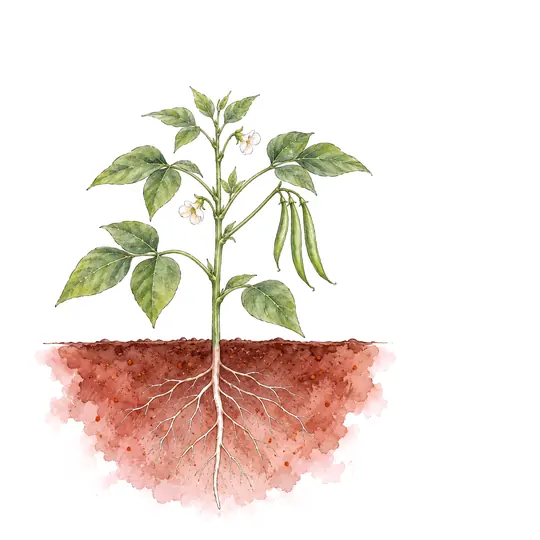
Calcium rides the water
a bean plant at pod set
the leaves pull most of the water, so they get most of the calcium

How it moves
Roots take calcium up and it goes wherever the water goes. Grown, open leaves pull hard on that stream, so they get plenty. Fruit pulls far less, and less again as it sizes, so fruit can fall short even when the leaves look fine.
And it barely moves once it’s in. The plant can’t shift calcium from old leaves into new growth or fruit the way it can with more mobile nutrients like nitrogen or potassium. Fruit, and the young leaves folded inside a head or a growing point, also lose very little water, so little calcium is pulled to them. So shortages show up in new tissue first. Bitter pit in apples, blossom-end rot in tomatoes and tip burn in lettuce are the classic examples.
On the plant, look at the growing points. The youngest leaves come out hooked, cupped or crinkled at the edges, and their tips scorch or die. In lettuce and cabbage, the inner leaves of the head brown at their edges, out of sight until you cut it. Below the ground, the root tips stop growing and go short and stubby. Most often, though, it’s the fruit that shows it, while the leaves look fine, because the leaves win the race for the water.
Water, carrying calcium.
-
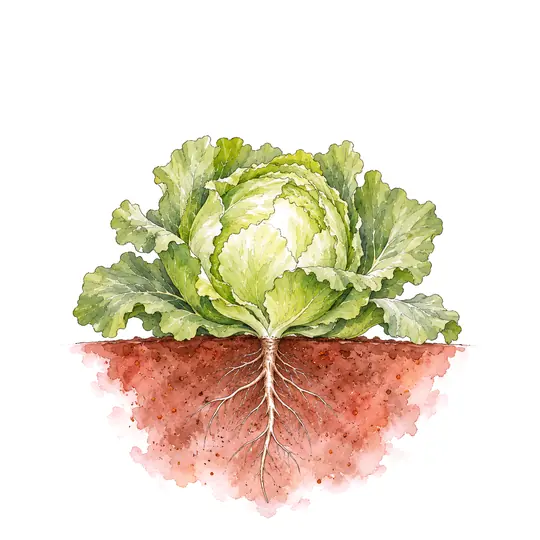
Whole
a head lettuce, near cutting
the outer leaves pull the water, and the calcium rides in with it
-
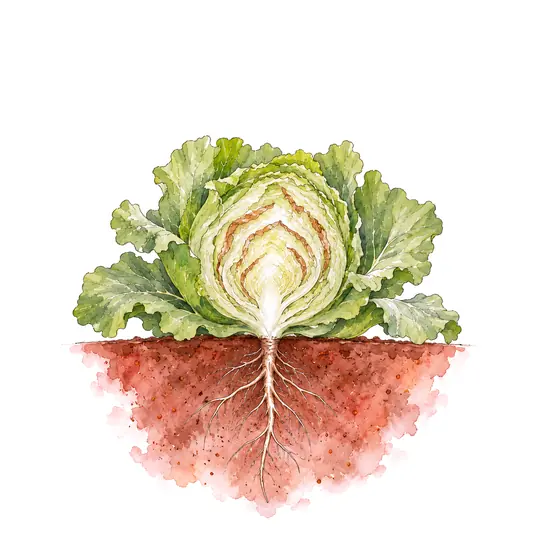
Cut in half
the same lettuce
the inner leaves, folded away, lose little water and get little calcium: their edges brown, out of sight


Potatoes have it harder still. A tuber underground loses almost no water, so the stream that feeds the leaves brings it very little calcium. It takes its calcium from the soil right beside it, through small roots on the stolons and the tuber. See potatoes.
The cell division window
In many crops, fruit makes most of its cells early. Steve’s rule of thumb: days in row crops like beans, weeks in tree crops. After that the fruit mostly grows by filling the cells it already has. The calcium built in during that window sets the fruit up for the season. That’s why the timing matters, not only the amount.
Calcium.
-
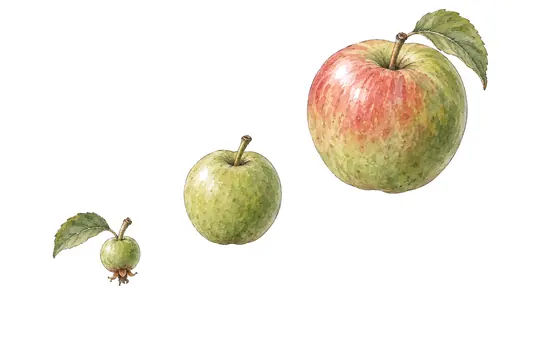
The cell division window
days in beans, weeks in tree crops
most of a fruit’s cells are made early: that’s the window that counts for calcium

What Steve saw in a bean crop
Steve reads calcium in the trend of a crop’s sap tests. In one bean crop’s report, it dropped hard right through cell division. “See that? See, your plant’s actually using calcium,” he told the grower. His reading: these beans would size up fast, on the water and the potassium, but on a weak frame. So next season, a calcium foliar goes in at that stage.
One thing to rule out before you read a drop that way: a crop short of water reads low on calcium too, because calcium only goes where the water goes. If it’s been dry, look at the water first, and test again once the crop’s drinking.
When it matters most, crop by crop
The stages where calcium is one of the minerals that matter most, in the program builder’s seasons. Each bar is a whole season, from sowing or planting to harvest, or a tree’s year. Build yours in the program builder.
-
Potatoes about 120 days
Sprout development · Stolon development · Vegetative growth · Tuber initiation (hooking) · Tuber bulking · Maturation
-
Beans about 70 days
Vegetative growth · Bud development · Flowering · Cell division · Cell expansion and sizing · Maturity
-
Carrots about 120 days
Sowing to establishment · Root initiation · Early bulking · Maturity
-
Onions about 180 days
Germination and root establishment · Early vegetative structure · Bulb initiation and cell division
-
Poppies about 140 days
Emergence · Hook to flowering
-
Sweet corn about 90 days
Sowing to emergence · Cob formation · Tasselling and silking · Picking
-
Cotton about 180 days
Planting to establishment · Squaring · Flowering and boll set · Boll opening to picking
-
Wheat about 170 days
Sowing to emergence · Heading and flowering
-
Avocados a year
Winter: flower buds · Flowering · Fruit set and cell division · Harvest and recovery
-
Apples a year
Green tip to half-inch green · Petal fall · Fruit set, 6 to 10 mm · Colour and ripening · Harvest
Getting it in
Most of a crop’s calcium comes from the soil, from lime, gypsum and what’s already there, and it reaches the plant only as fast as the water carries it in. When a stage needs it in the new growth, a foliar puts it right there, on time. It has to land on the growth it’s for, because it won’t move on from where it lands.
Calcium. A spray of calcium. Calcium missing. Can’t move on.
-
On the leaves
a bean plant at pod set
the calcium stays in the leaves it lands on, and the pods still go short of calcium
-
On the young pods
the same bean
it lands on the growth it’s for, and goes in right there
In the tank, keep it away from sulphates: they can drop out together.
Calcium and phosphate are a different problem. Left to themselves, they find each other and lock up as a solid: no use to the plant, and it blocks the nozzles. What keeps them apart is acidity. Phosphoric acid keeps a tank acid, so calcium acetate or calcium nitrate can go in with the phosphorus and are much less likely to drop out. A chelator, like fulvic acid or amino acids, isn’t enough on its own: the phosphate pulls harder than it holds. Without the acid, they lock up. Jar test a new mix first. See foliar or soil.
Which calcium you use counts too. Calcium acetate carries carbon with it, as acetate: a small molecule the plant already uses, one of the building blocks it makes its fats from. It goes into a blend kept acid with phosphoric acid, so it can go on with the phosphorus, in the base at planting or a top-up later.
On the leaf, smaller molecules get in better. A leaf takes a spray in through tiny pores in its waxy skin, and what’s dissolved and small goes through them most easily: the smaller, the faster. So calcium held in a small chelate gets in better than a big one. See foliar or soil.
What to do with it
- Plan calcium stage by stage, through the critical stages of influence, so it’s there as the new cells are made, not after the problem shows.
- Keep the water moving. A stressed, shut-down plant isn’t moving calcium anywhere.
- In sap tests, watch new leaves as well as old: shortages start at the top.
- In fruit that’s stored, like apples, test the fruit itself before the pick. Its calcium, set against its potassium and magnesium, shows how likely it is to break down in store. See apples.
- Build the foundation first. Potassium comes after.
“Earn the right to use potassium.”